One Phone Call, Armed Response: Tracing the Kill Chain of America's Swatting Attacks
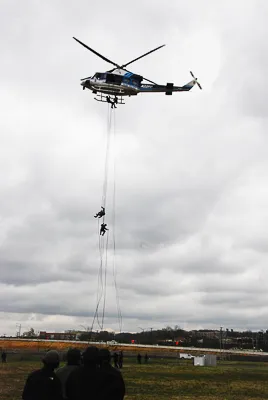
Photo: US Park Police, Public domain, via Wikimedia Commons
The call comes into a 911 center from someone claiming to have shot a family member and taken hostages, or to have rigged the house with explosives. The voice is calm, the details specific, the address precise. Within minutes, a tactical unit is rolling. The family inside the house knows none of this — until flashbangs detonate in the hallway or rifles are leveled at them on their own front lawn.
This is swatting: the deliberate weaponization of emergency response against a person who has done nothing. And the people who commit it are often thousands of miles from the scene.
From Gaming Feuds to a Federal Charge
The practice germinated in online gaming communities of the late 2000s, where rival players and trolls escalated from harassment to prank calls to emergency services. It matured into something darker. In 2015, a man in a Long Island home answered his door and was killed by police responding to a false hostage report traced to a prankster in the Los Angeles area. Two years later, a hoax call over a disputed video game wager sent a Wichita police officer to the wrong address entirely, where he shot and killed 28-year-old Andrew Finch — a man with no connection to the dispute whatsoever.
The Wichita case became the defining prosecution. The caller, Tyler Barriss, received a 20-year federal sentence, and the man who commissioned the hoax was convicted as well — establishing that ordering a swatting attack is itself a crime with real culpability, not a juvenile prank.
The Routing Problem
What makes swatting so difficult to police is architectural. Spoofed caller ID is trivially available. Voice-over-IP services let a caller in one country appear to be dialing from a local exchange in another. Many hoax calls pass through teletype relay services intended for deaf and hard-of-hearing users — a legitimate accessibility technology that perpetrators exploit because it anonymizes voice and complicates call tracing.
By the time investigators untangle the route — a spoofed number, relayed through a gateway, originating overseas — the tactical team has long since come and gone, and the trail has often crossed multiple jurisdictions and national boundaries where extradition is slow or impossible. Federal prosecutors have responded with statutes targeting false emergency reports and threats transmitted across state lines, and the FBI now maintains a national swatting database to link incidents. But prosecutions remain the exception; the overwhelming majority of attacks produce no arrest.
Living Behind the Door
For targets, the aftermath is its own sentence. Public figures, streamers, and journalists are frequent victims, but so are ordinary people whose addresses leaked after a doxxing incident, and — with growing alarm among law enforcement — so are randomly selected homes when callers read addresses from search results. Some victims install exterior cameras, register with local police flag programs, or move. A handful of departments now maintain voluntary registries allowing residents to note that their address has been targeted, giving dispatchers a moment of hesitation before treating a panicked call as gospel.
That hesitation is where prevention actually lives. Several 911 centers have adopted verification protocols — requiring callback confirmation, cross-checking caller location against the reported address, training call-takers to recognize the scripted patterns of hoax calls. Schools and hospitals, increasingly frequent targets of bomb-threat swatting, have developed parallel drills.
The Gap That Remains
The technology that enables the crime — cheap spoofing, global routing, anonymous relay — evolves faster than the statutes constraining it. International cooperation remains the weakest link, and until telecom providers face real liability for the anonymization services they carry, the kill chain will remain intact: one fraudulent call, one armed response, one household that will never fully trust a knock at the door again.