Needles on Paper: The Hundred-Year Fraud America Refuses to Turn Off
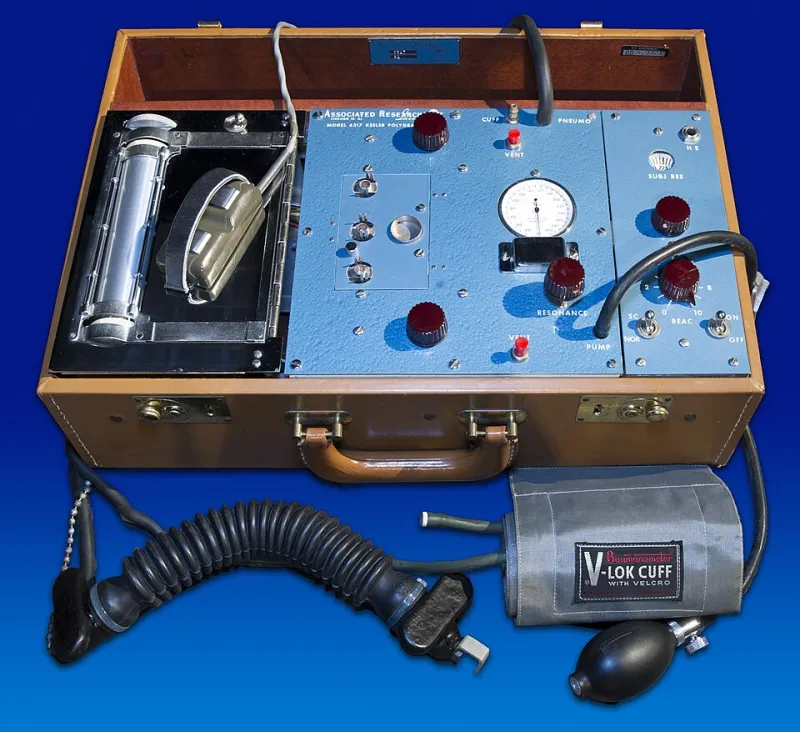
Photo: Federal Bureau of Investigation (FBI), Public domain, via Wikimedia Commons
The machine is elegant in its simplicity: rubber tubes strapped across the chest, a blood pressure cuff squeezing the arm, galvanometers translating sweat into ink. Three pens scratch a story onto moving paper, and somewhere in that story, the examiner claims, lies the truth about guilt and innocence.
There is only one problem. There is no such thing as a lie detector.
The Science That Walked Away
In 2003, the National Academy of Sciences delivered what should have been a eulogy. Its landmark review concluded that the physiological responses measured by polygraphs—breathing, heart rate, perspiration—are not markers of deception at all. They are markers of stress, and innocent people under interrogation are nothing if not stressed. The report found no scientific basis for the polygraph's central claim and noted that its accuracy rates, even in the most favorable studies, were inflated by selection bias.
Federal courts followed suit. Under the Federal Rules of Evidence and the Daubert standard, polygraph results are inadmissible in nearly every jurisdiction, treated with the same skepticism once reserved for phrenology. The Supreme Court in United States v. Scheffer (1998) noted the machine's 'troubled history' and the profound doubts about its reliability.
And yet the machine never left the building.
Who Still Trusts the Ink
The Department of Defense employs hundreds of polygraph examiners. The FBI, CIA, and NSA administer tens of thousands of tests annually, and a failed or 'inconclusive' exam can end a career before it begins—or, in the case of federal security clearances, keep one from ever starting. Local police departments continue to use polygraphs as investigative leverage, telling suspects that the machine 'knows' when they lie, a claim no court in the country would tolerate from an expert witness.
The interrogation industry has refined this into theater. Examiners are trained in techniques with names like the 'zone comparison technique'—a method whose scientific validation has been repeatedly challenged—and in pre-test interviews designed to extract admissions before a single needle touches paper. The polygraph's true function, critics argue, is not detection but confession production: a prop that makes coercion feel like science.
The Profits Behind the Pressure
A private polygraph examination runs from a few hundred dollars to well over a thousand. The industry includes examiner schools, equipment manufacturers, and a cottage trade in 'countermeasure' training for those who fear the machine. Post-conviction sex offender testing programs—now mandatory in a number of states—have created a recurring revenue stream that did not exist a generation ago, subjecting probationers to serial examinations whose failures can trigger revocation hearings, all based on a tool no court would admit into evidence.
Federal spending on polygraph programs, spread across agencies, is estimated in the tens of millions annually. The machine's inability to survive cross-examination has, paradoxically, been its business model: it operates in the spaces where scrutiny is thinnest—hiring offices, interrogation rooms, probation appointments.
Failing a Test for a Crime That Never Happened
The human cost is not hypothetical. Innocent people have spent years as suspects after failed polygraphs in cases later solved by DNA evidence. In documented exonerations, suspects who 'failed' their exams were telling the truth; the machine registered the panic of an innocent person accused of the unthinkable. Conversely, trained subjects—some guilty, some merely rehearsed—have passed with ease. Jeffrey Dahmer, in a case often cited by examiners themselves, reportedly passed a polygraph before his crimes were uncovered.
Reform proposals surface regularly. Some states have restricted employer-mandated testing through the Employee Polygraph Protection Act of 1988, though law enforcement remains exempt. A handful of jurisdictions have barred polygraph results in post-conviction proceedings. But no federal agency has abandoned the machine, and the security clearance apparatus depends on it more heavily each decade.
The polygraph endures because it is useful to power—useful for narrowing suspect pools without evidence, useful for pressuring confessions, useful for screening employees on the cheap. Science gave up on the lie detector a century into its life. The question is why American justice never did.