Warehouse of the Unsolved: When Cold Case Evidence Becomes a Commercial Commodity
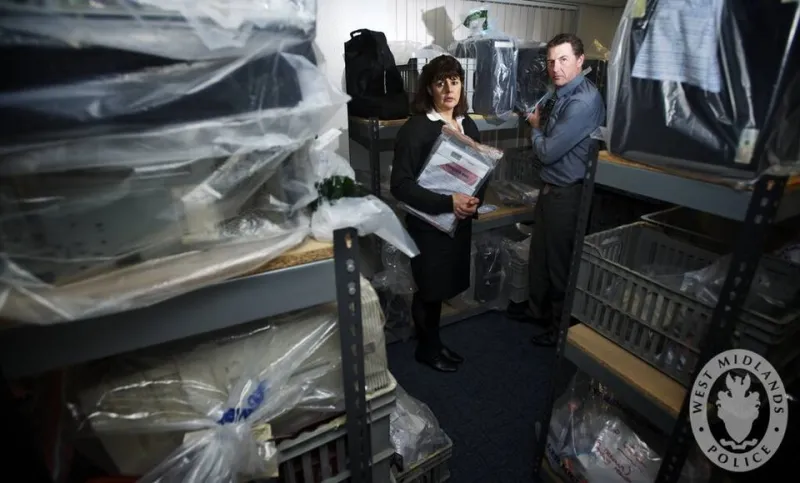
Photo: West Midlands Police from West Midlands, United Kingdom, CC BY-SA 2.0, via Wikimedia Commons
The evidence locker at a mid-sized police department in the American Midwest looks unremarkable from the outside: a corrugated steel annex behind the station, shelves bowing under boxes of case files, bagged clothing, and sealed envelopes of swabs collected from victims whose cases went cold before the millennium.
What happened to those boxes next is the story few departments want to discuss. Facing a storage crisis that auditors have flagged in jurisdictions from Cleveland to Albuquerque, a growing number of agencies are transferring their oldest evidence — including sexual assault kits and biological samples — into the hands of private warehousing contractors. Some contracts are straightforward leases. Others, investigators and advocates say, edge toward something more troubling: the quiet liquidation of evidence that no one has ever tested.
The Storage Crisis Nobody Budgeted For
Evidence retention is the unglamorous sediment of the criminal justice system. Every conviction generates decades of mandatory retention; every unsolved case generates more. A 2017 survey by evidence-management researchers found that a majority of American police departments reported being at or near storage capacity, and many acknowledged destroying evidence — including biological material — before required retention periods expired.
Into that gap has stepped a private industry. Companies now advertise climate-controlled, barcoded, chain-of-custody-compliant storage for law enforcement agencies, some charging by the box, others offering to take entire backlog inventories off a department's hands. On paper, the model is sensible. In practice, critics say, it has created a shadow archive of American criminal evidence that answers to contract terms rather than court orders.
Chain of Custody, For Sale
Chain of custody is the legal spine of physical evidence. Every transfer is supposed to be documented, every handler accountable. But defense attorneys and cold case investigators describe a murkier reality once evidence leaves a police facility.
One former crime lab analyst, who spoke to Criminal Class Press on condition of anonymity because she still works in the field, described auditing a private facility that held evidence from three different agencies. 'There were boxes from the nineties with rape kits inside that had never been sent to a lab. Nobody had ever requested them. The department that owned them had been consolidated with another agency years ago. As far as anyone could tell, no living person was responsible for that evidence.'
She recounted finding boxes with broken seals, inventory lists that didn't match contents, and biological samples stored in conditions that compromised DNA integrity. 'You can't un-degrade a sample. Once it's gone, the last chance at an answer is gone with it.'
What the Contracts Say — and What They Don't
Public records requests filed by this publication and by transparency advocates reveal contracts that vary wildly. Some require certified chain-of-custody logging and barcoded tracking. Others contain no provisions at all about testing access, retention timelines, or what happens if the contractor goes out of business — a scenario with real precedent, including a 2023 bankruptcy in which a private evidence facility's contents were briefly slated for disposal before a court intervened.
More alarming to advocates is the fee structure. Several departments have reportedly been billed storage fees on evidence they no longer wanted, and in some cases have simply declined to pay, allowing contracts to lapse. What happens to abandoned evidence under a lapsed contract is, in many jurisdictions, governed by nothing more than the contractor's own internal policy.
The Families Left Holding Empty Boxes
For victims' families, the stakes are not abstract. When a cold case is reopened — often because of a new DNA database hit or a fresh witness — investigators must first locate the original evidence. Increasingly, they can't.
Advocacy groups that track sexual assault kit backlogs report cases in which victims, decades after their assaults, finally requested testing only to learn their kits had been shipped to a private vendor whose records were incomplete or whose facility had been sold. The victim's last legal recourse had literally changed hands, without her knowledge, and arrived degraded or missing.
Restoring Custody to the Public
Reform is not complicated, but it does require will. States should mandate that any evidence transfer to a private facility preserve full public ownership, court-enforceable chain of custody, and a statutory right to testing on request. Contractors handling biological evidence should be subject to the same accreditation standards as public crime labs. And no evidence — not one box, not one kit — should ever be subject to lien, sale, or disposal for unpaid storage fees.
Cold case evidence is not surplus property. It is the last honest witness in thousands of unsolved cases, and it deserves better than a shelf in someone's warehouse — rented by the month, owned by no one, and answerable to no court.