The Merchants of Bail: How a Private Trade Became the Shadow Author of America's Pretrial Laws
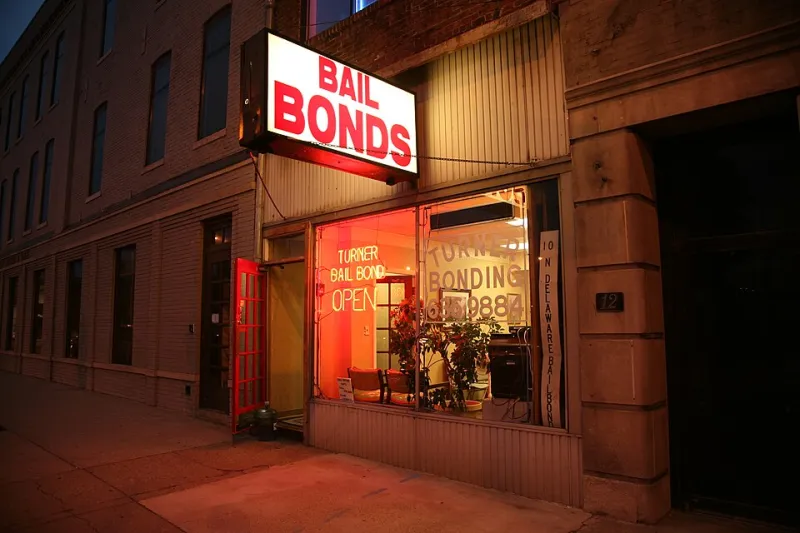
Photo: Daniel Schwen, CC BY-SA 4.0, via Wikimedia Commons
In 1914, a consortium of reformers, jurists, and social workers gathered in Cleveland for the first National Conference on Criminal Law and Criminology. Among their resolutions was a modest aspiration: release arrested people pending trial whenever possible, unconditionally. The idea that liberty before conviction should be the default was, at the time, considered common sense.
A century later, the United States remains the only nation on Earth where a for-profit bail bond industry operates at scale. And the record shows it did not survive by accident. It survived by legislating.
An Industry Born of a Loophole
Commercial bail in America traces to San Francisco in the 1890s, when brothers Thomas and Peter McDonough began charging arrested men a fee — typically 10 percent — to post surety with the court. The arrangement exploited a gap in the law: while the Eighth Amendment prohibited excessive bail, nothing prohibited a private party from selling access to it.
What began as a workaround hardened into an institution. By mid-century, bondsmen were fixtures outside every urban courthouse in America, and by the 1960s, an estimated 85 percent of pretrial releases nationally ran through their ledgers. The federal Bail Reform Act of 1966 and the Supreme Court's Stack v. Boyle decision had declared release the norm. The bondsmen's trade flourished anyway — because the statutes on the books mattered less than the statutes being written in state capitols.
The Statehouse Playbook
Campaign finance disclosures and lobbying expenditure reports across a dozen states reveal a consistent pattern. In Texas, industry-aligned political action committees have funneled millions to legislative candidates since 2015, much of it during sessions when bail reform bills moved through committee. In Georgia, bond industry contributions surged in the same two-year window that lawmakers passed a measure restricting counties from adopting their own release mechanisms.
The playbook is not subtle once you know to look for it. Industry groups opposing pretrial reform frame the issue around victim safety and flight risk, commission polling designed to generate alarming headline numbers, and deploy testimony from former judges and prosecutors on their payroll. Meanwhile, the public risk assessment tools that reformers champion — and that the bondsmen's business model cannot survive — are painted as algorithms that coddle criminals.
In states where reform has succeeded, the pattern runs in reverse: campaign contributions from the industry drop sharply, and bills move. The correlation is not proof of causation, but the legislative record — committee votes, amendment language traceable to industry model bills, floor speeches quoting trade association talking points nearly verbatim — makes the direction of influence difficult to dispute.
Kentucky's Warning and New Jersey's Lesson
Two states illustrate what happens when the industry loses. Kentucky abolished commercial bail for most cases in 1976; bondsmen have spent nearly five decades attempting to claw the market back through repeated legislative campaigns, each defeated. New Jersey's 2017 reform — funded in part by a tax on the bail industry itself — produced a 44 percent drop in the jail population awaiting trial, with failure-to-appear rates essentially unchanged.
The industry's response in both states has been the same: fund ballot initiatives, sue in state court, and lobby county officials to slow-walk implementation. In Kentucky, bondsmen succeeded in winning a legislative study commission as recently as 2022 that recommended studying a return to commercial surety — a provision widely credited to industry lobbying.
The Unelected Author
No American voted for the bail bond industry. It holds no constitutional office. Yet its fingerprints are on the pretrial statutes of most states — in the fee caps that guarantee its margin, the restrictions that shield it from competition, and the defeat of reform measures that threatened its existence.
The reform movement's question was supposed to be simple: who should decide liberty before trial — a judge weighing evidence, or a businessman weighing a fee? For a century, the answer has been decided in rooms the public never entered, by people whose names appear on no ballot.
That is not a system. That is a transaction. And it is overdue for an audit.