Seen by Everyone, Protected by No One: The Surveillance Blind Spots That Condemn the Innocent
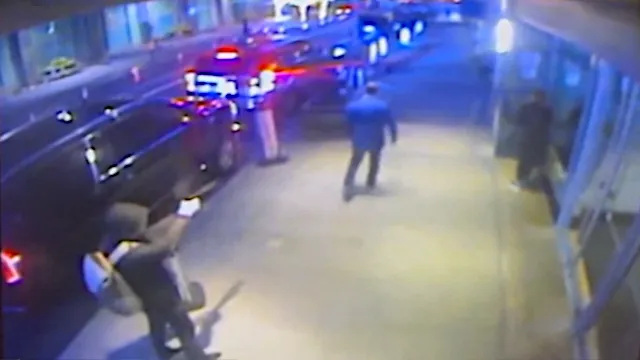
Photo: No human author, CCTV, Public domain, via Wikimedia Commons
The United States is, by most credible estimates, one of the most surveilled nations in the developed world. Tens of millions of cameras—mounted on ATMs, traffic signals, retail storefronts, transit stations, and residential doorbells—capture the movements of ordinary Americans from the moment they step outside their front doors. Law enforcement agencies have built entire investigative strategies around this architecture of observation, routinely pulling footage to place suspects at crime scenes, trace getaway routes, and corroborate witness accounts.
Yet a profound and underreported contradiction sits at the heart of this surveillance state: the same system that can apparently track a suspect to a parking garage at 11:47 p.m. on a Tuesday regularly fails to produce footage that might exonerate the person that suspect is accused of being. Cameras malfunction. Recordings overwrite themselves on 48-hour loops. Businesses decline to preserve footage without a subpoena—and by the time a subpoena arrives, the window has closed. Jurisdictional boundaries mean that a camera mounted on a county transit bus and one mounted on a private gas station across the street operate under entirely different legal frameworks, retention schedules, and access procedures.
For defendants who need that footage to establish an alibi, the result is not a technical inconvenience. It is, in many cases, the difference between freedom and a decade in prison.
The Myth of Omniscient Coverage
Public perception of surveillance technology has been shaped largely by crime dramas and prosecutorial press conferences, both of which tend to present camera networks as seamless and comprehensive. The reality is considerably messier. Urban centers like New York, Chicago, and Los Angeles operate layered networks that combine municipal cameras with privately owned systems—but coordination between those systems is inconsistent at best. Suburban and rural jurisdictions often operate with far sparser coverage, relying on whatever cameras local businesses happen to have installed.
More critically, the existence of a camera does not guarantee the existence of usable footage. Studies and case reviews conducted by innocence advocacy organizations have repeatedly documented instances where cameras that should have captured an alibi-confirming event were found to be non-operational, pointed in the wrong direction, or recording at a resolution too low to be meaningful. In one documented case reviewed by the Innocence Project, a defendant insisted he had been captured on an ATM camera at the time of the crime he was charged with committing—only for investigators to discover that the machine's camera had been out of service for weeks and the bank had failed to report the malfunction.
When Retention Policies Become Weapons
Perhaps the most structurally damaging feature of America's surveillance patchwork is the absence of any uniform standard governing how long footage must be retained. Federal law imposes no general mandate on private businesses to preserve security recordings. State laws vary dramatically. Municipal policies, where they exist at all, apply only to government-operated systems. Private entities—which own the majority of cameras in most American cities—set their own retention windows, which commonly range from 24 hours to 30 days, with many defaulting to the lower end of that range for storage cost reasons.
The implications for criminal defense are severe. An arrest may not occur until weeks after the alleged offense. Defense counsel may not be retained until weeks after that. By the time an attorney thinks to request footage from the convenience store two blocks from the crime scene—footage that might show their client walking in the opposite direction at the relevant time—that recording has been overwritten three times over.
Prosecutors, by contrast, often receive law enforcement requests for footage within hours or days of an incident, while the recordings still exist. The asymmetry is not incidental. It is structural, and it consistently advantages the state.
Case Studies in Lost Alibis
The consequences of this asymmetry are not hypothetical. Across the country, post-conviction review organizations have catalogued cases in which defendants maintained from the outset that surveillance footage would confirm their whereabouts—and in which that footage was never secured.
In one Illinois case, a man convicted of armed robbery argued that traffic camera footage from an intersection near his home would have shown him driving away from the area at the time the robbery was being committed across town. By the time his public defender formally requested the footage from the city's transportation department, the relevant recordings had been deleted pursuant to the department's standard 30-day retention policy. The conviction stood.
In a separate case out of Georgia, a defendant charged with assault claimed he had been inside a chain pharmacy at the time of the incident, a fact he believed the pharmacy's internal camera system would confirm. The pharmacy's corporate policy retained in-store footage for 14 days. The defense request arrived on day 19. No footage was produced. No alibi was established.
These are not isolated failures. They represent a recurring pattern that innocence organizations and criminal defense attorneys describe as endemic to the current system.
The Defense Access Problem
Even when footage does exist within its retention window, defense attorneys frequently encounter barriers that their prosecutorial counterparts do not. Law enforcement agencies can issue administrative subpoenas and make informal requests backed by the implicit authority of the state. Defense counsel, operating without that institutional weight, must navigate formal legal processes that take time—time the retention clock does not pause for.
In jurisdictions where defendants are represented by overburdened public defenders managing caseloads that can exceed 200 active cases, the practical capacity to identify, request, and litigate for surveillance footage is severely limited. Private defense attorneys with investigative resources fare better, but the majority of criminal defendants in the United States cannot afford private counsel. The surveillance alibi problem is, in this respect, also a poverty problem.
Some jurisdictions have begun exploring legislative remedies. A handful of states have introduced bills that would require businesses to preserve footage for extended periods upon notification that it may be relevant to a criminal proceeding—notification that could come from a defendant or defense attorney, not just law enforcement. These proposals have faced resistance from business lobbying groups citing storage costs and operational burden.
A System That Watches Without Witnessing
What emerges from a close examination of surveillance gaps in American criminal justice is a system that has enthusiastically embraced the prosecutorial potential of mass observation while systematically failing to extend its evidentiary benefits to the accused. The cameras are there. The recordings, in many cases, are not—or are not there long enough, or are not accessible to the people who most need them.
The legal principle that a defendant is entitled to evidence that may support their innocence is well established. The practical infrastructure to honor that principle, in an era when the most relevant evidence is often digital and ephemeral, has not kept pace. Until retention standards are standardized, access procedures are equalized, and defense teams are given the investigative resources to act quickly enough to matter, the surveillance state will continue to function as a tool of conviction far more reliably than it functions as a safeguard of innocence.
For the defendants caught in those blind spots, the cameras that were supposed to be watching were watching for everyone except them.